
Construction Project Management: A Step-by-Step Guide to Successful Project Delivery
A practical guide to organizing, planning, executing, monitoring, and closing out a construction project—from the initial project objectives to the final handover.
Managing a construction project is a coordinated process that brings together people, materials, equipment, information, time, cost, quality, safety, and contractual requirements. Each of these elements affects the others. A delay in procurement can affect the construction schedule; a change in scope can affect cost, resources, and completion dates; and an unresolved site condition can disrupt planned activities.
Successful project delivery therefore requires more than supervising daily site activities. It requires a structured management approach that connects the project objectives to practical plans, assigns clear responsibilities, establishes measurable controls, and provides a process for responding when actual conditions differ from expectations.
Whether the project involves a residential building, commercial development, industrial facility, or infrastructure work, the fundamentals of construction project management remain closely related. The scale, technical requirements, stakeholders, and contractual arrangements may differ, but the need for disciplined planning and control remains.
Construction project management is not a one-time planning exercise. It is a continuous process of establishing objectives, preparing the work, coordinating execution, measuring performance, managing changes, and verifying that the completed project meets its approved requirements.
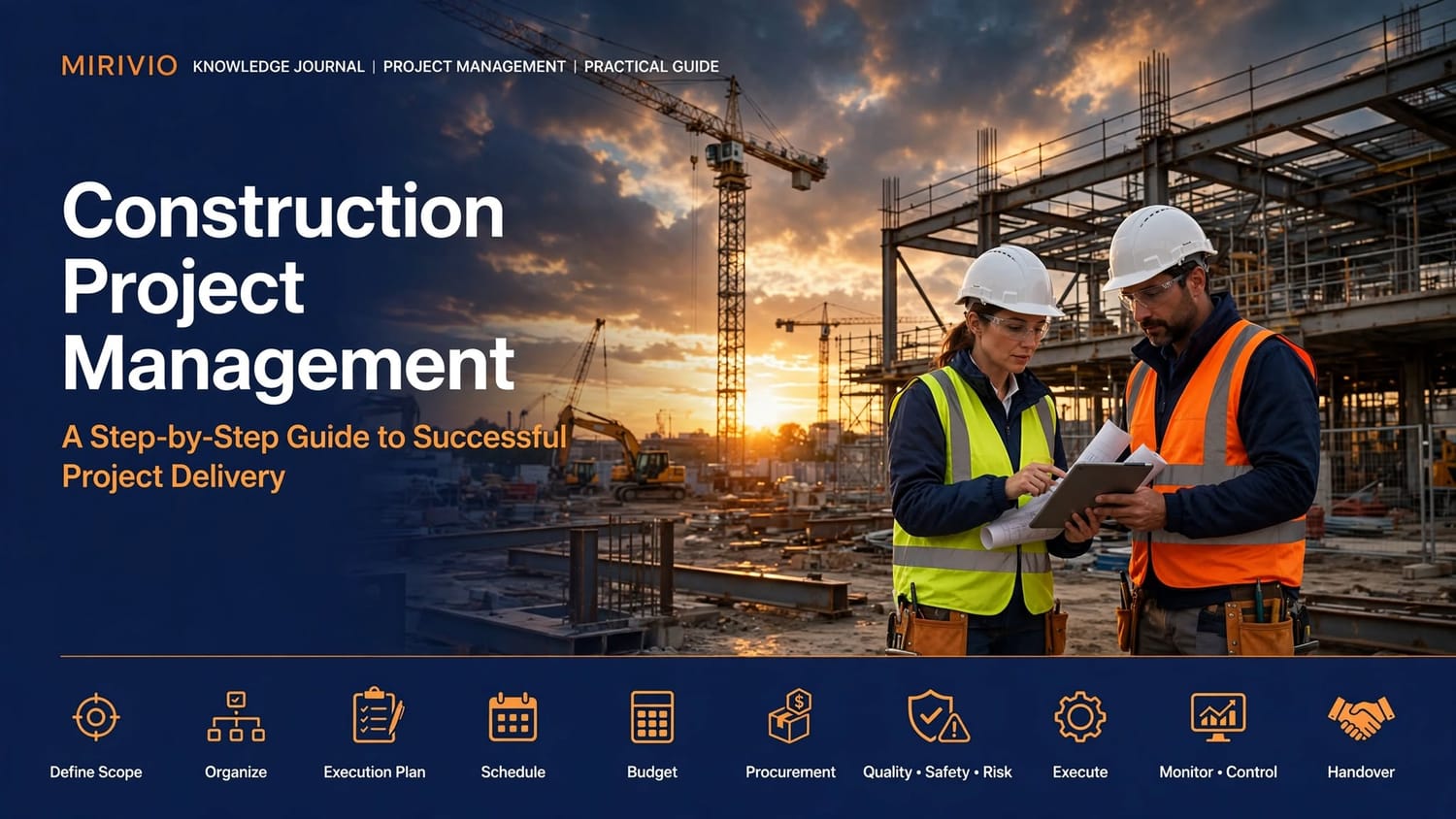
- Define the project objectives and scope
- Establish the project organization and responsibilities
- Develop the Project Execution Plan
- Prepare the construction schedule
- Establish the project budget and cost controls
- Plan procurement and resource requirements
- Establish quality, safety, and risk management procedures
- Execute and coordinate construction activities
- Monitor performance, control changes, and take corrective action
- Complete, hand over, and close out the project
- Essential project management documents
- Common construction project management mistakes
- Frequently asked questions
Understanding the Construction Project Management Process
Construction project management can be organized into a sequence of connected management activities. These activities provide a practical framework for translating project requirements into an executable plan and managing that plan throughout construction.
The sequence presented in this guide is a practical working framework, not a rigid formula. Some activities overlap, and several management processes continue throughout the project. For example, risk management, cost control, quality assurance, document control, and stakeholder coordination should not stop when construction begins.
The following 10 steps provide a structured approach that project managers and construction teams can adapt to the size, complexity, contract arrangement, and delivery requirements of their projects.
Step 1 — Define the Project Objectives and Scope
Every construction project should begin with a clear understanding of what must be delivered and what constitutes successful completion. Before developing detailed schedules or assigning resources, the project team needs to establish the project's purpose, requirements, boundaries, and expected outcomes.
Project objectives should be specific enough to guide planning and decision-making. General statements such as "construct a quality building" are not sufficient on their own. The team needs to understand the required facility, its intended function, performance expectations, contractual obligations, and acceptance requirements.
Key activities
- Review the contract, approved drawings, specifications, and other project requirements.
- Confirm the project location, site conditions, access restrictions, and known constraints.
- Identify the required project deliverables and major milestones.
- Establish the project scope, including inclusions, exclusions, and interfaces.
- Identify the client's expectations and acceptance criteria.
- Document assumptions, constraints, and initial project risks.
- Identify statutory approvals, permits, and regulatory requirements relevant to the project.
Important management consideration: Scope clarity
Scope definition is essential because it establishes what the project team is responsible for delivering. Unclear boundaries can result in duplicated work, omitted activities, disputes, and additional costs.
For example, a building project may involve civil, structural, architectural, mechanical, electrical, plumbing, fire protection, external works, and utility connections. The project team should understand which work packages are included in the contract and how their interfaces will be coordinated.
Before moving into detailed planning, make sure the project team can clearly explain what will be delivered, what is excluded, who is responsible, and how completion will be accepted.
Typical outputs
- Project Charter or Project Brief
- Project Scope Statement
- Initial Project Requirements Register
- Project Constraints and Assumptions Register
- Initial Stakeholder Register
Step 2 — Establish the Project Organization and Responsibilities
A construction project involves multiple parties with different responsibilities, authority, and interests. These may include the project owner, consultants, general contractor, subcontractors, suppliers, regulatory authorities, utility providers, and end users.
The project manager must establish how these parties will work together. An effective organization structure clarifies reporting relationships, decision-making authority, communication channels, and accountability.
Key activities
- Identify the project stakeholders and participating organizations.
- Establish the project organization chart.
- Define the responsibilities and authority of key project personnel.
- Identify the required project management, engineering, technical, and site supervision roles.
- Establish approval and escalation procedures.
- Define coordination arrangements between disciplines and contractors.
- Set regular communication and reporting requirements.
Use a responsibility assignment matrix
A Responsibility Assignment Matrix (RAM) helps clarify who performs, approves, supports, or receives information about specific project activities. A RACI matrix is one commonly used approach:
- Responsible: The person or team performing the work.
- Accountable: The person answerable for the outcome and approval.
- Consulted: The parties whose input is required.
- Informed: The parties who need to receive updates.
| Project Activity | Project Manager | Site Engineer | QA/QC Engineer | Procurement |
|---|---|---|---|---|
| Baseline schedule approval | Accountable | Consulted | Informed | Consulted |
| Daily site coordination | Accountable | Responsible | Consulted | Informed |
| Material procurement | Accountable | Consulted | Consulted | Responsible |
| Inspection and testing | Informed | Consulted | Responsible | Informed |
This is an illustrative responsibility arrangement only. Actual assignments should reflect the contract, organization structure, delegated authority, and project procedures. A person may hold more than one role depending on project size.
Typical outputs
- Project Organization Chart
- Roles and Responsibilities Matrix
- RACI Matrix
- Communication Matrix
- Project Contact Directory
Step 3 — Develop the Project Execution Plan
The Project Execution Plan (PEP) explains how the project will be organized, managed, coordinated, and controlled. It connects the project objectives and contractual requirements to the procedures and management arrangements that the team will follow.
Rather than treating the plan as a document prepared only for submission, the project manager should use it as a practical management reference throughout project execution.
What should the Project Execution Plan cover?
- Project background, objectives, and scope.
- Project organization, authority, and reporting relationships.
- Construction methodology and major work packages.
- Schedule development, monitoring, and reporting procedures.
- Cost management and financial reporting arrangements.
- Procurement, subcontracting, and material management.
- Quality management, inspection, and testing procedures.
- Health, safety, and environmental management arrangements.
- Risk management and issue escalation.
- Document control, technical submissions, and change management.
- Stakeholder communication and coordination.
- Testing, commissioning, handover, and closeout requirements.
Connect the plan to actual project operations
The PEP should be consistent with the approved contract documents, project requirements, and applicable management procedures. It should also identify the supporting plans, registers, and records that will be maintained by the project team.
For example, the schedule management section should explain how progress will be measured, how schedule updates will be prepared, who will review delays, and how recovery actions will be evaluated. Simply attaching a Gantt chart does not establish a complete schedule management process.
A good Project Execution Plan should answer five questions: What must be done? Who is responsible? How will it be done? When will it be done? How will performance be measured and controlled?
Typical outputs
- Project Execution Plan
- Construction Management Plan
- Project Procedures Register
- Project Reporting and Communication Plan
- Supporting discipline-specific management plans
Step 4 — Prepare the Construction Schedule
The construction schedule translates the project scope into a time-based sequence of activities. It establishes the planned order of work, activity durations, logical relationships, milestones, and overall completion requirements.
A schedule should be developed from the actual scope and construction methodology—not simply from an arbitrary target completion date. It must consider site conditions, design information, procurement lead times, labor availability, equipment, access, permits, and other constraints.
Key activities
- Break down the project scope into manageable work packages using a Work Breakdown Structure (WBS).
- Identify the activities required to complete each work package.
- Establish activity durations based on quantities, productivity, resources, and working conditions.
- Define activity dependencies and logical relationships.
- Identify critical activities and the critical path.
- Include design, approvals, procurement, mobilization, testing, and commissioning activities.
- Identify major milestones and contractual completion dates.
- Review resource requirements and schedule constraints.
- Obtain the required review and approval of the baseline schedule.
Understand the critical path
The critical path is the sequence of activities that determines the earliest possible project completion date based on the schedule's logic and durations. Delays to critical activities can directly affect the overall completion date unless corrective action or approved schedule changes alter the sequence.
However, project managers should not focus only on critical-path activities. Near-critical activities, procurement milestones, interfaces, and activities with limited float can also create significant schedule exposure.
Make procurement part of the schedule
One common scheduling weakness is treating procurement as a separate administrative activity. Materials and equipment required for construction should be integrated into the project schedule.
For long-lead items, consider the complete process: technical specifications, material approval, quotation, purchase order, fabrication, inspection, shipping, delivery, and site availability. The required-on-site date should be coordinated with the construction sequence.
A technically complete schedule may still be unrealistic if it ignores restricted site access, working hours, weather exposure, local labor availability, delivery limitations, or coordination with other contractors. Validate the schedule with the people responsible for executing the work.
Typical outputs
- Work Breakdown Structure
- Detailed Construction Schedule
- Project Milestone Schedule
- Critical Path Analysis
- Procurement Schedule
- Resource Loading or Resource Plan
- Approved Baseline Schedule
For a related discussion of schedule performance and common sources of delay, read: Why Construction Projects Fall Behind Schedule: 7 Common Causes and How to Prevent Them .
Step 5 — Establish the Project Budget and Cost Controls
Cost management ensures that the project is delivered within the approved financial parameters while maintaining the required scope and quality. It involves more than recording expenses after they occur. The project team needs a system for establishing the budget, monitoring commitments, measuring actual costs, forecasting the final cost, and managing changes.
Key activities
- Review the contract price, approved budget, and cost breakdown.
- Develop a cost structure aligned with the WBS and work packages.
- Identify direct costs such as labor, materials, equipment, and subcontract work.
- Identify indirect costs such as site overhead, temporary facilities, supervision, and project administration.
- Establish procurement commitments and subcontract cost tracking.
- Monitor actual costs and committed costs against the approved budget.
- Prepare regular cost forecasts and estimate the cost to complete.
- Evaluate the financial impact of proposed variations and changes.
- Report cost variances and recommend corrective actions.
Understand the difference between budget, commitments, and actual cost
| Cost Element | Meaning | Management Purpose |
|---|---|---|
| Approved Budget | The authorized financial allowance for the project or work package. | Establishes the cost baseline. |
| Committed Cost | Costs already contractually committed, such as purchase orders and subcontracts. | Shows financial obligations that may not yet be fully incurred. |
| Actual Cost | Costs incurred and recorded to date. | Measures expenditure already recognized. |
| Forecast Final Cost | The projected total cost at completion based on current information. | Provides an early indication of the expected final financial result. |
Use cost reporting to support decisions
A useful cost report should explain not only how much has been spent but also what remains to be spent and whether the forecast is changing. A project may appear to be within budget based on actual expenditure while carrying substantial unrecorded commitments or future cost exposure.
The project manager should coordinate cost reporting with progress measurement, procurement, subcontract administration, and change control. This makes it easier to identify cost pressures before they become serious financial problems.
Typical outputs
- Approved Project Budget
- Cost Breakdown Structure
- Cost Control Procedure
- Procurement and Commitment Register
- Actual Cost Report
- Cost Forecast and Estimate at Completion
- Variation and Change Cost Register
Step 6 — Plan Procurement and Resource Requirements
Construction work depends on the timely availability of materials, equipment, labor, subcontractors, technical information, and site facilities. Even a well-developed schedule can become unachievable when critical resources are not available when required.
Procurement and resource planning should therefore be coordinated with the construction methodology, project schedule, approved budget, and site conditions.
Key activities
- Identify materials, equipment, and services required for each work package.
- Determine which items require early procurement or long lead times.
- Prepare material and equipment schedules.
- Establish technical submittal, sample, and material approval requirements.
- Identify potential suppliers and subcontractors.
- Evaluate supplier capacity, delivery commitments, and commercial conditions.
- Plan labor requirements based on the construction sequence and productivity assumptions.
- Coordinate equipment mobilization, site access, storage, and handling.
- Monitor delivery status and resolve procurement constraints.
Develop a procurement tracking system
A procurement register provides visibility over critical purchasing activities. It should identify the item, responsible person, required date, approval status, purchase order status, supplier commitment, expected delivery, and current issues.
For example, structural steel, elevators, generators, switchgear, specialized mechanical equipment, and imported materials may require early coordination. Their procurement activities should be planned around the dates when approved materials must be available at the site.
Consider project location and logistics
Resource planning must reflect the actual project environment. Remote locations, islands, restricted urban sites, limited storage, road access, weather conditions, and local supplier capacity can significantly affect delivery and manpower arrangements.
The project team should identify these constraints during planning rather than waiting until the construction activity is ready to begin.
If a critical material is not approved, ordered, fabricated, or delivered in time, the construction activity may not proceed as planned. Procurement status should be reviewed alongside schedule performance during regular project coordination meetings.
Typical outputs
- Procurement Management Plan
- Procurement Schedule
- Material Submittal Register
- Purchase Order Register
- Delivery Tracking Register
- Labor and Equipment Resource Plan
- Subcontractor Register
Step 7 — Establish Quality, Safety, and Risk Management Procedures
Quality, safety, and risk management should be integrated into the project from the beginning. They are not activities that should be introduced only after work has started or when problems occur.
The project manager must ensure that the team understands the applicable requirements, responsibilities, inspection arrangements, hazard controls, risk response actions, and reporting procedures.
A. Quality management
Quality management establishes how the project will verify that materials, workmanship, installations, and completed work comply with approved drawings, specifications, contract requirements, and applicable standards.
- Establish the project quality requirements and acceptance criteria.
- Prepare inspection and test plans where required.
- Identify inspection hold points and witness points.
- Establish material approval and testing procedures.
- Monitor workmanship and construction compliance.
- Record nonconformities and assign corrective actions.
- Maintain inspection, testing, and quality records.
B. Health, safety, and environmental management
Construction activities expose workers and other stakeholders to hazards that must be identified and controlled. The project should establish appropriate safety responsibilities, procedures, training, permits, inspections, and emergency arrangements in accordance with applicable legal and project requirements.
- Identify construction hazards and assess associated risks.
- Prepare activity-specific risk assessments and method statements as required.
- Establish site induction and toolbox meeting arrangements.
- Implement applicable permit-to-work procedures.
- Inspect equipment, temporary works, access, and work areas.
- Establish emergency response and incident reporting procedures.
- Monitor environmental controls, waste handling, and site housekeeping.
C. Risk management
Risk management helps the project team identify uncertainty that may affect project objectives and determine appropriate responses. Risks can arise from design development, procurement, labor, construction methods, weather, site conditions, logistics, interfaces, approvals, and external stakeholders.
A practical risk management process includes:
- Identify potential risks.
- Assess their likelihood and potential impact.
- Prioritize risks requiring attention.
- Assign a risk owner.
- Define appropriate response actions.
- Monitor risk indicators and response progress.
- Review and update the risk register as conditions change.
A risk register is useful only when its actions are implemented and monitored. If procurement delays are identified during planning, the project team should assign an owner, establish an action date, and monitor the supplier or approval process before the delay affects site activities.
Typical outputs
- Project Quality Management Plan
- Inspection and Test Plans
- Safety Management Plan
- Activity Risk Assessments
- Project Risk Register
- Risk Response and Action Register
- Nonconformance and Corrective Action Register
For a deeper discussion of the risk process, see: Construction Project Risk Management: 8 Practical Steps to Identify, Assess, and Control Risks .
Step 8 — Execute and Coordinate Construction Activities
Once the necessary planning, approvals, resources, and site arrangements are in place, the project team can proceed with construction execution in accordance with the approved plans and contractual requirements.
Execution is where project planning is tested against actual site conditions. The project manager must coordinate the work of different disciplines, monitor daily activities, resolve constraints, and maintain communication among project participants.
Key activities
- Conduct project mobilization and site establishment.
- Confirm approved drawings, specifications, and construction information are available.
- Coordinate daily and weekly work activities.
- Verify that labor, equipment, materials, and work areas are ready.
- Coordinate subcontractors and trade interfaces.
- Monitor construction methodology and work sequencing.
- Conduct regular site inspections and coordination meetings.
- Resolve technical queries and site constraints through established procedures.
- Maintain daily records of work progress, manpower, equipment, and site conditions.
Use look-ahead planning
The approved baseline schedule provides the overall project direction, but site teams also need shorter-term plans that translate the schedule into executable activities.
A two-week or three-week look-ahead schedule, for example, can identify upcoming activities, required materials, equipment, drawings, approvals, labor, and access requirements. The period should be appropriate to the project's complexity and work cycle.
Before an activity is released for execution, the responsible team should verify that the necessary prerequisites are available. This may include approved drawings, materials, permits, access, equipment, inspection arrangements, and preceding work completion.
Coordinate interfaces between work packages
Construction activities are interdependent. Structural work may need to be completed and inspected before architectural finishes can proceed. Mechanical and electrical installations may require coordination with structural openings, ceiling spaces, and architectural layouts.
Poor interface management can result in rework, clashes, delays, and disputes. The project team should establish coordination procedures and resolve conflicting requirements before they affect work on site.
Typical outputs
- Daily Site Reports
- Weekly and Monthly Progress Reports
- Look-Ahead Schedules
- Site Coordination Meeting Minutes
- Technical Query and RFI Register
- Inspection Requests and Site Records
- Manpower and Equipment Reports
Step 9 — Monitor Performance, Control Changes, and Take Corrective Action
Monitoring and controlling determine whether the project is progressing according to its approved plans and whether action is required to address deviations. This process should operate continuously throughout construction.
The project manager must compare actual performance against established baselines, identify variances, evaluate their causes and impacts, and coordinate appropriate responses.
Monitor the key project performance areas
| Control Area | What to Monitor | Possible Management Response |
|---|---|---|
| Schedule | Planned versus actual progress, milestones, critical activities, and delays. | Resequence work, remove constraints, or evaluate recovery measures. |
| Cost | Actual expenditure, commitments, budget variances, and forecast final cost. | Investigate cost exposure and implement approved cost-control actions. |
| Quality | Inspection results, testing, nonconformities, and corrective actions. | Correct defective work and prevent recurrence. |
| Resources | Labor availability, equipment utilization, and material supply. | Adjust resource deployment or resolve supply constraints. |
| Risk | Risk status, triggers, response actions, and emerging threats. | Implement response plans and reassess exposure. |
| Scope and Changes | Design revisions, instructions, variations, and approved changes. | Assess impacts and follow the formal change process. |
Use performance reporting to identify deviations early
Progress reports should provide a clear comparison between planned and actual performance. Reporting only the percentage of work completed is not enough. The project manager also needs to understand why a variance occurred, which activities are affected, and what action is required.
For example, if a structural work package is behind schedule, the team should determine whether the cause is drawing approval, material availability, labor productivity, equipment limitations, access restrictions, rework, or another constraint. The response should address the actual cause rather than simply requesting the site team to work faster.
Manage changes through a formal process
Changes may arise from revised design information, client instructions, unforeseen site conditions, regulatory requirements, or modifications to the project scope.
Every proposed change should be documented and evaluated before implementation in accordance with the contract and project procedures. The assessment should consider:
- Scope and technical requirements.
- Cost and commercial implications.
- Schedule and milestone impacts.
- Resource and procurement requirements.
- Quality, safety, and regulatory implications.
- Contractual approvals and authorization requirements.
The project team should maintain a change register to track requests, evaluations, approvals, implementation status, and related documentation. Work should be authorized and administered in accordance with the applicable contract and delegated authority.
A delay report tells you that performance has deviated from the plan. Effective project control goes further: it identifies the reason, evaluates the impact, assigns responsibility, establishes an action, and checks whether that action works.
Typical outputs
- Project Progress Reports
- Schedule Update and Variance Reports
- Cost Reports and Forecasts
- Risk and Issue Registers
- Change Request and Change Log
- Corrective Action Register
- Management Review and Coordination Meeting Minutes
Step 10 — Complete, Hand Over, and Close Out the Project
Project completion involves more than finishing the physical construction work. The project team must verify that the required work has been completed, outstanding issues have been addressed or formally recorded, testing and commissioning requirements have been satisfied, and the necessary handover documents have been prepared.
Closeout should be planned early enough to avoid a last-minute accumulation of incomplete documentation, unresolved defects, missing approvals, and outstanding contractual obligations.
Key activities
- Verify completion of the contractual scope and required deliverables.
- Complete inspections, testing, and commissioning as applicable.
- Prepare and resolve the outstanding works and defects list.
- Compile as-built drawings and final technical records.
- Collect operation and maintenance manuals, warranties, and equipment information.
- Complete required training and operational handover activities.
- Submit completion documentation and obtain the required acceptance or certification.
- Reconcile final quantities, variations, claims, and commercial accounts.
- Close procurement, subcontract, and administrative records as applicable.
- Conduct a project review and document lessons learned.
Prepare a structured handover package
The handover package should reflect the project contract and the client's operational requirements. Depending on the project, it may include:
- Approved as-built drawings.
- Operation and maintenance manuals.
- Testing and commissioning records.
- Equipment schedules and technical data.
- Warranties and guarantees.
- Inspection and quality records.
- Certificates, permits, and approvals.
- Training and handover records.
- Outstanding defects and corrective action records.
Capture lessons learned
The closeout process should also capture what worked well, what caused difficulties, and what should be improved on future projects. Lessons learned are most useful when they identify practical actions rather than simply describing problems that occurred.
For example, if a project experienced repeated delays due to late material approvals, the team could recommend earlier technical submittal planning, clearer approval responsibilities, and procurement milestones linked to the construction schedule.
Typical outputs
- Project Completion and Handover Checklist
- Testing and Commissioning Records
- As-Built Drawing Register
- Operation and Maintenance Manuals
- Defects and Outstanding Works Register
- Final Account and Commercial Closeout Records
- Lessons Learned Report
- Project Closeout Report
Essential Construction Project Management Documents
A structured document system supports project coordination, accountability, traceability, and informed decision-making. The exact documents required will depend on the project size, contract, delivery method, client requirements, and applicable regulations.
The following table provides a practical reference for the documents commonly used throughout the project lifecycle.
| Project Stage | Key Documents and Records |
|---|---|
| Project Initiation | Project Charter, Project Brief, Scope Statement, Stakeholder Register. |
| Organization | Organization Chart, RACI Matrix, Roles and Responsibilities Matrix, Communication Matrix. |
| Planning | Project Execution Plan, WBS, Baseline Schedule, Project Budget, Risk Register. |
| Procurement | Procurement Schedule, Material Submittal Register, Purchase Order Register, Delivery Register. |
| Quality and Safety | Quality Plan, Inspection and Test Plan, Risk Assessment, Safety Records, Nonconformance Register. |
| Execution | Daily Reports, Weekly Reports, Look-Ahead Schedule, Meeting Minutes, RFI Register, Inspection Requests. |
| Monitoring and Control | Progress Reports, Cost Reports, Schedule Updates, Change Log, Issue Register, Corrective Action Register. |
| Closeout | Handover Checklist, As-Built Register, O&M Manuals, Testing Records, Final Account, Lessons Learned Report. |
Documents should not be created merely to satisfy an administrative requirement. Each should serve a defined management purpose, have an assigned owner, be maintained at the appropriate revision, and be accessible to the people who need it.
How to Keep the Project Management Process Connected
The 10 steps are most effective when they operate as one connected management system. Project objectives guide the scope; the scope informs the WBS; the WBS supports schedule and cost development; procurement and resource plans support execution; and project controls measure whether the work is meeting the approved requirements.
When a change occurs, its impacts should be assessed across the connected plans. A change to one activity may affect the schedule, cost, procurement, quality, resources, and contractual obligations. The project manager must understand these relationships before decisions are made.
| Management Element | Primary Question |
|---|---|
| Scope | What must be delivered? |
| Organization | Who is responsible and authorized? |
| Execution Plan | How will the project be managed and delivered? |
| Schedule | When and in what sequence will the work happen? |
| Cost | What resources and financial commitments are required? |
| Procurement | Will materials, equipment, and services be available when needed? |
| Quality, Safety, and Risk | How will requirements, hazards, and uncertainties be managed? |
| Execution | Is the planned work being carried out as intended? |
| Monitoring and Control | What is changing, what is the impact, and what action is needed? |
| Closeout | Has the project been completed, accepted, and properly handed over? |
Common Construction Project Management Mistakes to Avoid
Even when a project follows a formal management process, weaknesses in implementation can affect its performance. The following mistakes are worth watching for:
1. Starting construction without sufficient planning
Beginning work before key drawings, approvals, work methods, resources, or site arrangements are ready can create avoidable delays and rework. Confirm critical prerequisites before releasing activities for execution.
2. Developing schedules without validating assumptions
Unrealistic durations, missing procurement activities, weak dependencies, and insufficient consideration of site constraints can make a schedule unreliable. Validate the schedule with the people responsible for delivering the work.
3. Treating procurement as a separate function
Procurement decisions affect the construction sequence. Coordinate technical approvals, purchasing, fabrication, and delivery with the baseline schedule and required-on-site dates.
4. Failing to assign clear responsibilities
When approval authority, reporting lines, and activity ownership are unclear, decisions can be delayed and important tasks can be overlooked. Define responsibility before execution.
5. Managing risks only after problems occur
Reactive management increases the likelihood that problems will affect the project before the team can respond. Identify risks early, assign owners, and monitor response actions.
6. Reporting progress without analyzing variances
A progress percentage does not explain why work is ahead or behind. Reports should identify the cause, impact, responsible party, and proposed corrective action.
7. Implementing changes without proper evaluation
Uncontrolled changes can affect cost, time, quality, and contractual obligations. Document proposed changes, evaluate their impacts, and obtain the required authorization.
8. Delaying closeout preparation
Missing as-built drawings, incomplete testing records, unresolved defects, and outstanding handover documents can delay project completion. Maintain closeout requirements throughout execution.
Practical Project Manager's Checklist
Use this summary checklist to review whether the fundamental management arrangements are in place. It is a general working reference and should be adapted to the specific project.
- Project objectives, requirements, and scope are clearly defined.
- Project organization, responsibilities, and authority are established.
- Project Execution Plan and supporting procedures are prepared.
- Construction methodology and work packages are identified.
- Baseline schedule and key milestones are established.
- Project budget and cost monitoring arrangements are established.
- Procurement and resource requirements are coordinated with the schedule.
- Quality, safety, and risk management procedures are in place.
- Site coordination and reporting arrangements are established.
- Progress, cost, risks, issues, and changes are regularly monitored.
- Corrective actions are assigned and followed through.
- Testing, commissioning, handover, and closeout requirements are tracked.
Frequently Asked Questions
1. What are the steps in construction project management?
A practical construction project management process includes defining project objectives and scope, establishing responsibilities, developing the Project Execution Plan, preparing the schedule, establishing cost controls, planning procurement and resources, establishing quality, safety, and risk procedures, executing construction, monitoring and controlling performance, and completing project handover and closeout.
2. What is the most important step in construction project management?
No single step guarantees project success. However, clear scope definition and effective planning provide the foundation for the other management activities. Weaknesses in these areas can affect the schedule, budget, resources, procurement, and execution. Strong monitoring and control are equally important throughout the project.
3. What documents are needed to manage a construction project?
Common documents include the Project Execution Plan, scope statement, organization chart, WBS, baseline schedule, project budget, procurement schedule, risk register, quality plan, safety procedures, progress reports, change log, and closeout checklist. The exact requirements depend on the project, contract, and client.
4. What does a construction project manager do?
A construction project manager coordinates the people, resources, information, and management processes needed to deliver the project. Responsibilities commonly include scope, schedule, cost, procurement, quality, safety, risk, stakeholder coordination, change management, progress reporting, and project closeout.
5. How do you control delays in construction projects?
Effective delay control begins with a realistic baseline schedule, coordinated procurement, resource planning, regular progress monitoring, and early identification of constraints. When a delay occurs, the project team should investigate its cause, evaluate its impact, and implement suitable corrective or recovery measures.
6. What is the difference between construction planning and construction project management?
Construction planning develops the approach, sequence, resources, schedule, and methods needed to perform the work. Construction project management is broader: it includes planning as well as organizing, executing, monitoring, controlling, coordinating, and closing out the project.
7. Can construction project management be applied to small projects?
Yes. The level of documentation and management effort should be proportionate to the project's size, complexity, risk, and contractual requirements. Even a small construction project benefits from clear scope, a realistic schedule, cost tracking, resource coordination, quality checks, and proper handover.
Successful Project Delivery Begins with a Structured Process
Construction project management is a continuous process of connecting project requirements with practical execution. It starts with understanding what must be delivered, establishing who is responsible, and preparing a realistic approach to the work. It continues through procurement, construction coordination, performance monitoring, change management, and final handover.
A project manager cannot eliminate every uncertainty or prevent every field condition from changing. However, a well-organized management system helps the team anticipate challenges, make informed decisions, coordinate resources, and respond to problems before they create greater consequences.
The objective is not simply to complete construction activities. It is to deliver the agreed project scope in accordance with the required quality, safety, cost, time, and contractual expectations.
Plan the work. Coordinate the people. Control the process. Deliver the project.
Turn Project Management Knowledge into Action
Apply structured project management practices using the MIRIVIO Construction Project Management Playbook, with editable templates and a digital book companion designed to support practical project planning, execution, monitoring, and control.
EXPLORE THE MIRIVIO PLAYBOOK →MIRIVIO.

Construction management systems, professional tools, and practical knowledge designed to help teams deliver projects with greater structure, control, and confidence.
Created with © systeme.io