
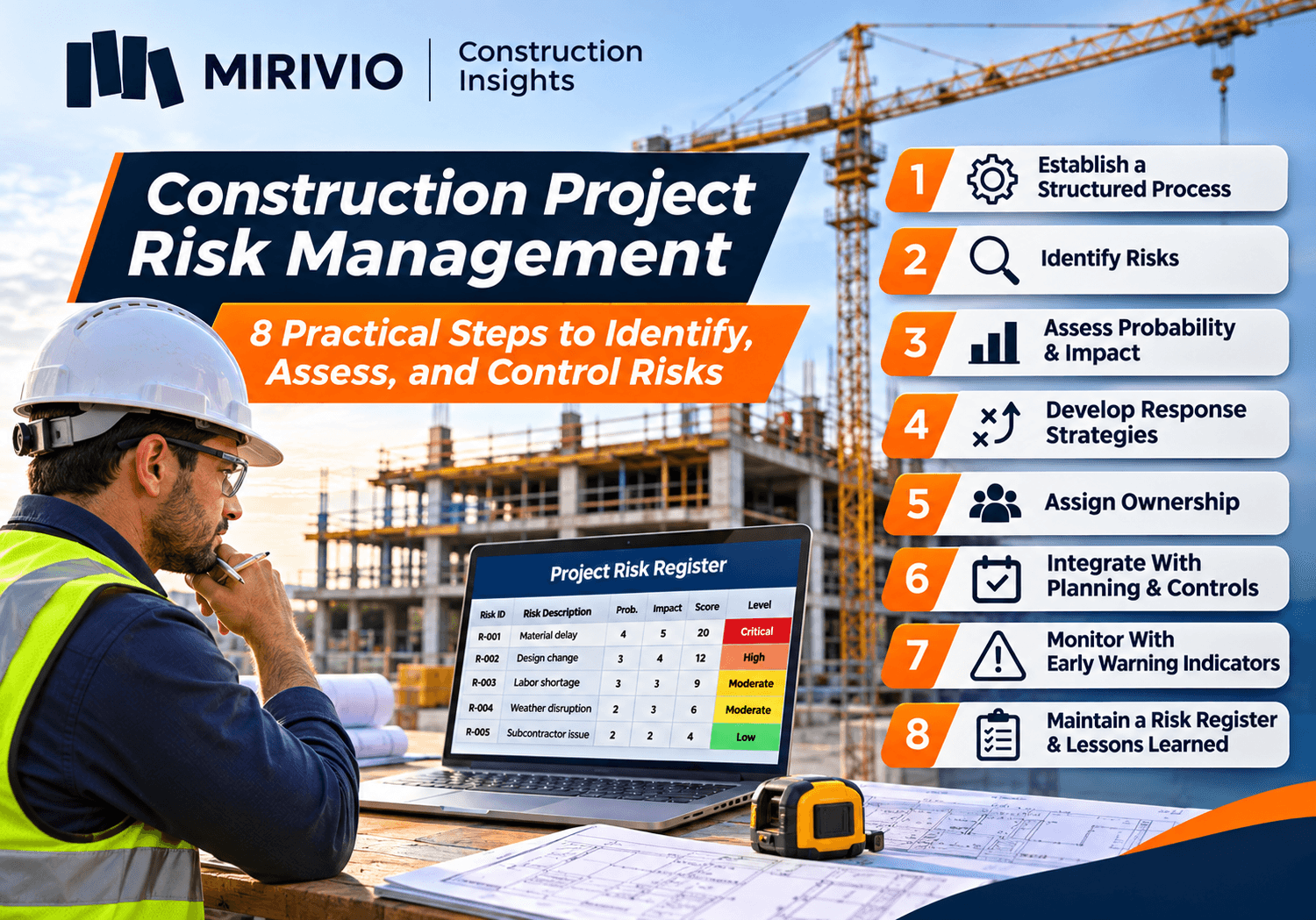
Construction Project Risk Management: 8 Practical Steps to Identify, Assess, and Control Risks
Construction projects involve uncertainty. Design changes, delayed procurement, labor shortages, unexpected site conditions, cost increases, and coordination problems can disrupt even carefully prepared project plans.
The challenge is not simply that risks exist. It is that many project teams identify them too late, when their consequences have already affected cost, schedule, quality, or project delivery.
Effective construction project risk management provides a structured way to identify potential problems, evaluate their consequences, assign responsibility, and implement appropriate responses before risks become actual project issues.
A risk management process should not be treated as a document prepared only during project planning. It should be integrated into daily project management, coordination meetings, schedule reviews, procurement monitoring, and project controls.
Here are eight practical steps to establish a more effective construction project risk management process.
1. Establish a Structured Risk Management Process
Risk management begins with a defined process that explains how risks will be identified, evaluated, assigned, monitored, and controlled throughout the project.
Without a consistent process, risk management often becomes reactive. Different departments maintain separate lists, responsibilities become unclear, and important risks may not receive timely attention.
A structured process should establish:
- How and when project risks will be identified.
- The criteria for assessing probability and impact.
- How risks will be prioritized.
- Who is responsible for each risk.
- What response strategies may be applied.
- How risks will be monitored and reported.
- How changes in risk status will be documented.
The process should be proportionate to the project's size, complexity, contract requirements, and delivery method.
Practical recommendation: Establish a project risk management procedure during project initiation or planning. Communicate it to the project manager, engineering team, construction team, procurement, commercial, and other relevant stakeholders.
2. Identify Risks Across All Project Activities
Risk identification should cover the entire project lifecycle, not just construction activities.
Some risks originate during design and procurement but become visible only when construction is underway. Identifying them early gives the project team more time and flexibility to respond.
Consider these common construction risk categories:
Design risks
- Incomplete or conflicting drawings.
- Late design approvals.
- Uncoordinated architectural, structural, and MEPF requirements.
- Changes in specifications or design criteria.
Schedule risks
- Delayed approvals and inspections.
- Unrealistic activity durations.
- Poor coordination of work sequences.
- Delays in critical materials and equipment.
Cost and commercial risks
- Inaccurate estimates.
- Unforeseen work and scope changes.
- Escalating material prices.
- Unresolved variations and claims.
Procurement risks
- Long-lead materials.
- Supplier production delays.
- Inadequate procurement planning.
- Limited availability of critical equipment.
Resource risks
- Labor shortages.
- Equipment breakdowns.
- Low productivity.
- Inadequate supervision or technical resources.
Site and safety risks
- Unforeseen ground or site conditions.
- Access restrictions.
- Weather disruptions.
- Unsafe work conditions and incidents.
Contractual and external risks
- Unclear contractual responsibilities.
- Delayed decisions by stakeholders.
- Permit and regulatory delays.
- Utility coordination and third-party dependencies.
Practical recommendation: Conduct risk identification workshops with the people directly involved in project execution. Review drawings, specifications, contracts, schedules, procurement logs, site conditions, and previous project lessons.
3. Assess Risk Probability and Potential Impact
Not all risks deserve the same level of attention. The project team must determine which risks are most likely to occur and which could have the greatest consequences.
A simple probability-impact matrix can help establish priorities.
Assign each risk:
- A probability rating from 1 to 5.
- An impact rating from 1 to 5.
- A risk score calculated by multiplying probability by impact.
An illustrative classification is:
| Risk score | Classification |
|---|---|
| 1–4 | Low |
| 5–9 | Moderate |
| 10–16 | High |
| 17–25 | Critical |
These thresholds are illustrative. Each project should establish its own criteria, including how financial, schedule, safety, quality, and contractual impacts are evaluated.
For example:
A critical electrical distribution panel is scheduled for delivery shortly before installation. The supplier has not confirmed its manufacturing progress.
- Probability: 4
- Impact: 5
- Risk score: 20
- Classification: Critical
This risk deserves immediate attention because a procurement delay could affect installation, testing, commissioning, and project completion.
Practical recommendation: Prioritize high and critical risks during project meetings. Do not rely exclusively on numerical scores. A low-probability safety or regulatory risk may still require immediate action because of the severity of its potential consequences.
4. Develop Appropriate Risk Response Strategies
Identifying and assessing risks is not enough. Every significant risk should have a planned response.
Four commonly used risk response strategies are:
Avoid
Change the project approach or activity to eliminate the threat.
Example: Revise a construction sequence to avoid performing critical work under unsafe site conditions.
Mitigate
Reduce the probability of occurrence, the potential impact, or both.
Example: Monitor supplier manufacturing progress and conduct inspections before the required delivery date.
Transfer
Allocate an agreed portion of the risk to another party through appropriate contractual or insurance arrangements.
Example: Use contractual provisions and suitable insurance to address defined transportation or third-party risks.
Accept
Acknowledge the risk and proceed without additional preventive action when appropriate, while establishing contingency measures or monitoring arrangements where necessary.
Example: Accept a minor weather-related productivity risk while maintaining reasonable schedule contingency.
The chosen strategy should be practical, proportionate, and consistent with contractual responsibilities.
Practical recommendation: Document the selected response, required actions, responsible person, target date, and expected outcome. A response strategy without assigned actions is unlikely to produce meaningful results.
5. Assign Clear Risk Ownership and Accountability
One of the most common weaknesses in construction risk management is the absence of clear ownership.
A risk may be identified and discussed repeatedly, but no one is formally responsible for monitoring it or ensuring that the agreed response is implemented.
Every significant risk should have a designated risk owner.
The risk owner is responsible for:
- Monitoring the risk.
- Coordinating the agreed response.
- Providing status updates.
- Identifying changes in probability or impact.
- Escalating the risk when necessary.
- Confirming when the risk is no longer active.
Risk ownership should be assigned to the person or function best positioned to manage the specific exposure.
For example:
| Risk area | Possible risk owner |
|---|---|
| Design coordination | Design Manager |
| Construction sequencing | Construction Manager |
| Procurement delays | Procurement Manager |
| Cost exposure | Cost Engineer / Commercial Manager |
| Safety exposure | Safety Manager |
| Overall project risk | Project Manager |
The Project Manager should maintain overall visibility and ensure that significant risks receive appropriate attention.
Practical recommendation: Avoid assigning every risk to the Project Manager. Distribute ownership according to actual responsibilities, authority, and ability to influence the outcome.
6. Integrate Risk Management With Project Planning and Controls
Risk management becomes more effective when it is connected to the project's existing management systems.
A risk register should not operate independently from the construction schedule, procurement log, cost report, change register, or quality and safety records.
For example:
- A procurement risk should be linked to the material delivery schedule.
- A design approval risk should be linked to the relevant activity or work package.
- A cost risk should be reflected in cost forecasts and contingency assessments.
- A potential scope change should be coordinated with the change management process.
- A safety risk should be addressed through the project's safety management procedures.
This integration helps the project team understand how one risk may affect several project objectives.
A delayed material delivery, for example, may affect not only procurement but also work sequencing, labor utilization, equipment deployment, overhead costs, and completion milestones.
Practical recommendation: Review the risk register alongside the project schedule, procurement status, cost report, and progress report. This makes risk management part of normal project control rather than an isolated administrative exercise.
7. Monitor Risks and Establish Early Warning Indicators
Project risks change over time. A risk considered moderate during planning may become critical when conditions deteriorate.
Regular monitoring helps the team identify changes before they develop into actual project problems.
Early warning indicators provide measurable signals that a risk may be increasing.
Examples include:
- Repeated delays in drawing approvals.
- Supplier progress falling behind agreed milestones.
- Increasing procurement lead times.
- Declining labor productivity.
- Repeated failed inspections.
- Increasing numbers of unresolved site instructions.
- Work activities approaching their planned start dates without approved drawings or materials.
Risk reviews should be conducted at appropriate intervals based on the project's complexity and risk exposure.
Critical risks may require more frequent monitoring than low-priority items.
Practical recommendation: Include risk status in regular project coordination and management meetings. Record changes in probability, impact, response actions, and escalation requirements.
8. Maintain a Centralized Risk Register and Capture Lessons Learned
A centralized risk register provides a consistent record of identified risks, assessments, assigned owners, planned responses, and current status.
It should be maintained as a working project control document.
At a minimum, a practical risk register should include:
| Field | Purpose |
|---|---|
| Risk ID | Unique reference number |
| Risk description | Clear statement of the potential event |
| Risk category | Design, schedule, cost, procurement, etc. |
| Probability | Likelihood of occurrence |
| Impact | Potential consequence |
| Risk score | Probability multiplied by impact |
| Priority | Low, Moderate, High, or Critical |
| Risk owner | Person responsible for monitoring |
| Response strategy | Avoid, Mitigate, Transfer, or Accept |
| Mitigation actions | Specific actions to address the risk |
| Target date | Required completion date |
| Status | Open, Monitoring, Escalated, or Closed |
Practical Example: Procurement Delay
Consider a project requiring a major electrical distribution panel.
| Register field | Example entry |
|---|---|
| Risk ID | R-001 |
| Risk description | Late delivery of electrical distribution panel |
| Category | Procurement / Schedule |
| Probability | 4 |
| Impact | 5 |
| Risk score | 20 |
| Priority | Critical |
| Risk owner | Procurement Manager |
| Response strategy | Mitigate |
| Mitigation actions | Confirm supplier commitment, monitor manufacturing progress, conduct progress checks, and identify alternative suppliers where feasible |
| Target date | Before the required delivery date |
| Status | Open / Monitoring |
The risk owner should update the register as new information becomes available.
When the risk is resolved or no longer relevant, its status should be updated and the outcome documented.
The project team should also capture lessons learned from risks that materialized, risks successfully prevented, and response strategies that were ineffective.
These lessons can improve risk identification and response planning on future projects.
Practical recommendation: Use one controlled risk register as the project's primary reference. Establish clear responsibility for updating it, reviewing outstanding actions, and maintaining accurate records.
Making Risk Management Part of Project Delivery
Construction project risk management is most effective when it is continuous, practical, and integrated into everyday project operations.
A well-maintained risk register alone does not guarantee successful risk management. The real value comes from identifying threats early, evaluating their potential consequences, assigning accountability, implementing appropriate responses, and monitoring results.
Project teams that establish these practices can make better-informed decisions, reduce avoidable disruptions, and improve control over project cost, schedule, quality, and delivery.
The objective is not to eliminate every uncertainty. It is to prepare the project team to recognize, manage, and respond to uncertainty before it compromises project objectives.
Strengthen Your Construction Project Management System
Effective risk management works best when supported by structured project controls, practical procedures, and consistent documentation.
The MIRIVIO Construction Project Management Playbook provides practical guidance and editable professional templates designed to help construction teams organize project activities, improve documentation, and strengthen project control.
Explore the MIRIVIO Construction Project Management Playbook:
Explore the MIRIVIO Construction Project Management Playbook →

Construction management systems, professional tools, and practical knowledge designed to help teams deliver projects with greater structure, control, and confidence.
Created with © systeme.io